
Kingfisher County Arrest Records and Court Charges
A Kingfisher County arrest record is the record of an arrest itself. It can note who made the arrest, the agency involved, and the booking that follows. In Kingfisher County, an arrest may come from the Sheriff's Office, a city police department, or the Oklahoma Highway Patrol. An arrest alone does not set the charges. After the arrest, the District Attorney reviews the case and decides what to file. The prosecutor then files the formal charges with the Kingfisher County Court Clerk. At that point the charges become part of the public court record. So an arrest starts the process, but the prosecutor shapes the charges that move forward.
The arrest side and the charge side live in different places. Booking detail and custody status sit with the sheriff and the county jail. For the Kingfisher County roster and booking data, the Kingfisher County inmate records page is the right stop. The court charge record is the other half. It tracks the charges the prosecutor filed and follows them through the case. The court charges after arrest show counts, codes, and status. The full case file, with pleas and the final outcome, is covered on the Kingfisher County criminal court records page.
Finding Kingfisher County Arrest Records
The charges filed after an arrest show up in the District Court case index. Two free portals carry those files. On Demand Court Records, or ODCR, is the main public search for Kingfisher County cases. The statewide docket site, OSCN, lists Kingfisher County District Court as well. Booking and custody detail are not in these court tools. That side lives in the jail roster instead.
- Open the ODCR portal and select Kingfisher from the court list.
- Search by defendant name in "Last, First" form, or enter a case number.
- Open the case and read the full charge list filed by the state.
- Check each charge's code, level, and current status on the docket.
Custody status can change fast, so a separate tool helps track it. Oklahoma VINE sends notice of custody and criminal case events. It is a useful path when you want to follow a person's case status after an arrest.

VINE covers custody and case alerts, not the full charge sheet. To read the charges in full, pair it with an ODCR or OSCN case search. Together they show both where a person stands and what the state has filed in Kingfisher County.
Court tools are not the only channel for a Kingfisher County charge record. In person, the Court Clerk works from Room 24 of the Kingfisher County Courthouse on South Main Street. The clerk's criminal division can confirm a case number, pull a charge sheet, or take a certified copy request. You can also reach the Kingfisher County Court Clerk by phone or by mail. When a charge is too new or too old for the online index, these direct channels are the fallback.
Charges Filed in Kingfisher County
The arrest happens first, then the charge record begins. A prosecutor starts a case by filing a charging document with the court. The document names the counts and ties each to a statute. Oklahoma uses three main types. The one used depends on the level of the crime and how the case reaches court.
| Complaint | Information | Indictment | |
|---|---|---|---|
| Filed By | Officer / Prosecutor | Prosecutor | Grand Jury |
| Common For | Misdemeanors | Many felonies | Serious felonies |
| Starts | The case | The case | The case |
Most Kingfisher County cases begin with a complaint or an information from the District Attorney. In Kingfisher County, the elected District Attorney is Tommy Humphries, and a managing attorney runs the local District 4 office. A grand jury indictment is less common and used for some serious felonies. Whichever document opens the case, the Kingfisher County Court Clerk records it and gives the file a case number. From there the charges are public unless a law closes them.
Charge Status in Kingfisher County Records
Charges are not fixed once they are filed. They can be amended, reduced, added, dropped, or dismissed as a case moves. The docket shows each change with a date. Reading the status tells you where each count stands now. The table defines the terms you will see most.
| Status | What It Means |
|---|---|
| Pending | The charge is filed and active but not yet resolved. |
| Amended / Reduced | The prosecutor changed the charge, often to a lower level. |
| Dismissed | The court dropped the charge, so it will not go forward. |
| Nolle Prosequi | The prosecutor chose not to pursue the charge. |
Note: A dropped or dismissed charge can still show on a Kingfisher County court record until the person seeks an expungement and a judge grants it.
Charges vs. Convictions
Being charged is not the same as being convicted. A charge is an accusation that the state must still prove. A conviction is a finding or plea of guilt entered by the court. A charge record can list counts that were later dropped or dismissed. Always read the disposition before drawing a conclusion. The columns below mark the line.
| Charge | Conviction | |
|---|---|---|
| Stage | Accusation | Verdict or plea |
| Burden of Proof | Probable cause | Beyond reasonable doubt |
| Public Record | Yes | Yes |
Sealed vs. Expunged Records
Oklahoma lets some people clear an eligible arrest or charge record. Sealing and expungement are close but not the same. A sealed record is hidden from public view. An expunged record is treated as if it never existed for most uses. Eligibility depends on the offense, the outcome, and the time since the case closed. The chart sums up the split.
| Sealed | Expunged | |
|---|---|---|
| Visibility | Hidden from public | Destroyed / treated as never existed |
| Law Enforcement | Limited access | Very limited |
| Eligibility | Arrests, dismissals, and acquittals under 22 O.S. §§ 18 and 19 | Qualifying deferred sentences under 22 O.S. § 991c |
An arrest with no charge filed may qualify for relief under the same statutes. A petition is filed in the District Court that handled the matter. Notice usually goes to the District Attorney and the agencies that hold the records. The Court Clerk can supply copies and case numbers but cannot give legal advice.
Kingfisher County Charge Codes and Levels
Each charge is tied to a section of the Oklahoma statutes. The code names the exact offense and points to the law behind it. Charges also carry a severity level. Felonies are the most serious and can bring prison time, while misdemeanors are lower-level crimes. In the District Court index, felony files use the prefix CF and misdemeanor files use CM.
One arrest can lead to several separate charges. A single Kingfisher County case number may hold more than one count, each with its own code, level, and status. That is why a Kingfisher County charge record is read count by count. Reading only the top charge can give a wrong picture of the whole case. The diversion programs run by the District 4 District Attorney can also change how a charge ends, since some counts route to restitution instead of a standard conviction.
Statewide Charge and History Lookups
Some charges roll up into statewide records once a case reaches sentencing. The Oklahoma Department of Corrections runs a public lookup for sentenced offenders and fugitives. The DOC offender lookup shows custody and sentence basics for people in the state system. The agency warns that its data is abbreviated and is not an exact account of the offense or the sentence.
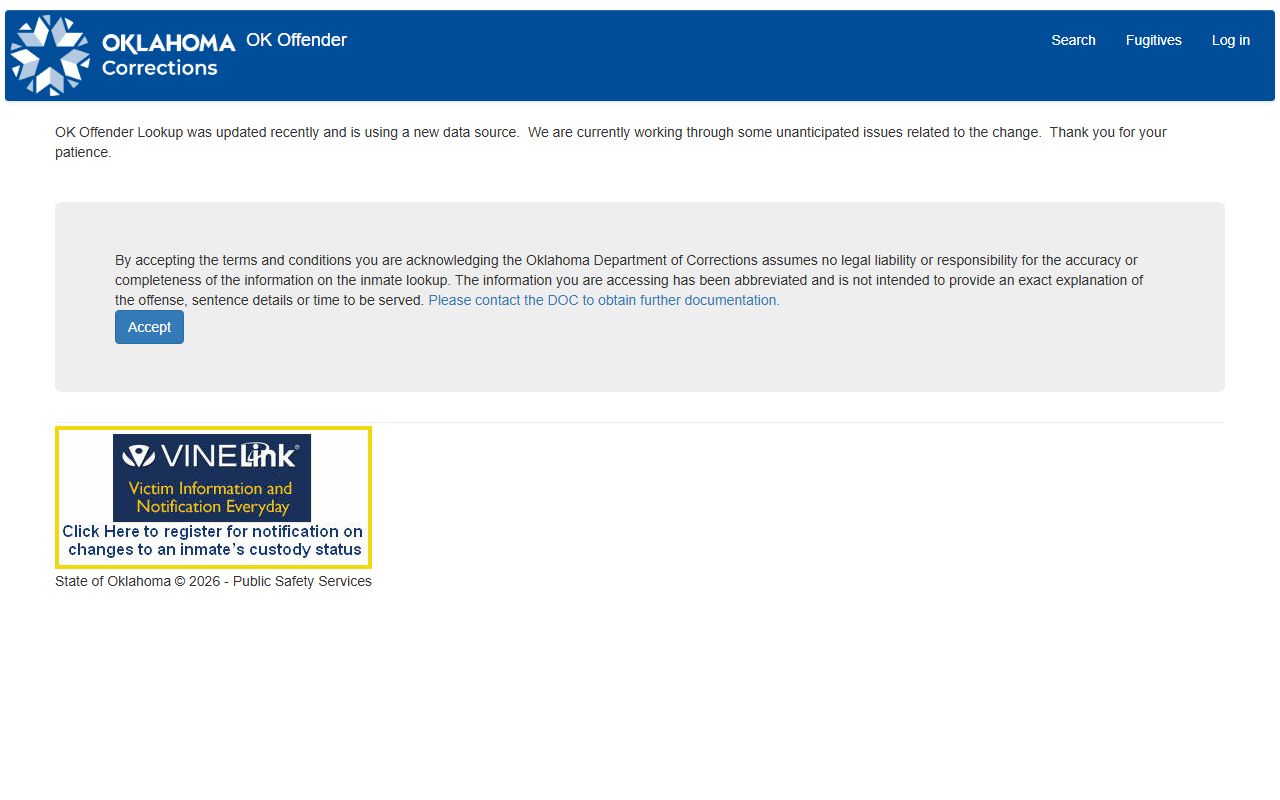
Use the DOC tool for state prison records, not for Kingfisher County jail custody. For sex-offender status, Oklahoma keeps a separate sex offender registry. The registry is its own search and is not a jail roster or a charge index. For a Kingfisher County case, the full file with each plea and the final result is laid out on the Kingfisher County criminal court records page.
Background Check Considerations
Many people read charge records to check a person's history. A quick search on ODCR or OSCN is not a formal background check. A regulated check follows the Fair Credit Reporting Act and uses a licensed agency. Court data can lag, omit a sealed case, or list a shared name. Confirm any match with the Court Clerk before you rely on it for a serious choice.
Important: This site is not a consumer reporting agency under the FCRA, and its records may not be used to screen for jobs, housing, credit, or insurance.
Restricted Charge Records in Kingfisher County
Not every charge record is open to the public. Juvenile charges are kept apart, and eligible juvenile records may be expunged under 10A O.S. § 2-6-109. Sealed and expunged adult cases drop from the public index or show only limited data. Dismissed charges can stay visible until a court orders them sealed.
Open investigations are also held back. An unserved search warrant, a protected victim address, or a minor's full details may not appear online. When a Kingfisher County charge is missing from the portal, the Court Clerk can confirm whether it is sealed, restricted, or simply not yet posted. For records of an active warrant tied to a charge, the Kingfisher County warrant search page explains how service and clearance work. Municipal charges from the City of Kingfisher or the Town of Hennessey may sit with a city court rather than the county index.