
Criminal Court Records in Kingfisher County
A criminal court record is the case file the court opens once a charge is filed. In Kingfisher County, the Court Clerk keeps these files for the District Court. The clerk's criminal division records and stores each filing, hearing, order, and result. A single record can run from the first charge to the final sentence. It holds the charging document, the docket of events, the plea, and the disposition. The file is the official account of what the court did. It is not the same as a jail booking sheet kept by the sheriff.
Kingfisher County District Court handles the serious criminal work. District judges hear both felony and misdemeanor cases filed by the state. The Associate District Judge sits in the Kingfisher County Courthouse and presides over local criminal dockets. Felonies carry the chance of prison time and use the case prefix CF. Misdemeanors are lower-level crimes and use the prefix CM. City ordinance crimes are different. Those minor matters route to the City of Kingfisher Municipal Court or the Town of Hennessey Municipal Court, not the county clerk. A search of the Kingfisher County District Court index will not always show a city case, so the venue matters.
More than one channel reaches a Kingfisher County criminal court record. In person, the Court Clerk works from Room 24 of the Kingfisher County Courthouse on South Main Street. The clerk's criminal division can pull a file, confirm a case number, or take a certified copy request. You can also call the Kingfisher County Court Clerk or write the office by mail. Older Kingfisher County criminal records that predate the online index are often easiest to reach this way.
Searching Kingfisher County Criminal Records
Two free portals carry Kingfisher County District Court cases. The Court Clerk links both from the county site. On Demand Court Records, known as ODCR, is the most visible public search for county case files. The statewide docket site, OSCN, also lists Kingfisher County District Court in its court menu. Either tool can pull up a criminal case by name or number.
- Open the ODCR portal and pick Kingfisher from the court list.
- Search by party name in "Last, First" form, or enter a full case number.
- Narrow the results by case type, such as Criminal Felony or Criminal Misdemeanor, and set a filed-date range.
- Open a case to read its docket, charges, plea, and disposition.
- Ask the Court Clerk for a certified copy when you need an official version of the file.
OSCN works best when you know the case number. Pick Kingfisher County District Court, then type a number in the form shown, such as CF-2014-1. Both portals can need scripting turned on for full features. For a certified Kingfisher County criminal court record, the Court Clerk follows the Oklahoma fee and bond schedules. The state charges in any case are filed and pursued by the District Attorney for District 4. The local District 4 DA office in Kingfisher handles prosecution and victim services for the county.
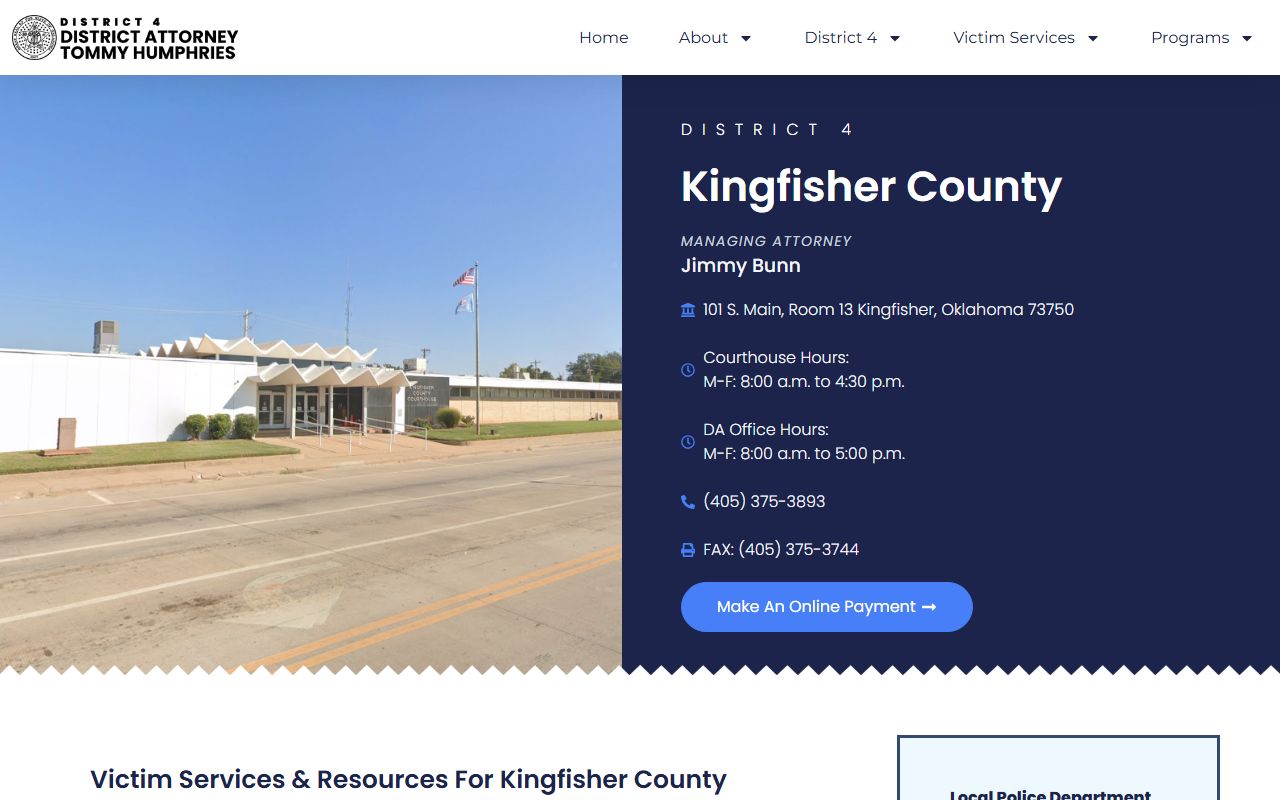
The District Attorney sets the formal charges, decides what to file, and carries the case in Kingfisher County District Court. Tommy Humphries serves as the District Attorney, and a managing attorney runs the day-to-day Kingfisher County office. The office also supports crime victims, so a victim can be told of case status, attend hearings, be heard at sentencing, and seek restitution. The closer look at the charges themselves sits on the Kingfisher County arrest records and charges page.
Stages of a Kingfisher County Criminal Case
A Kingfisher County criminal case moves through set stages, and each stage leaves a mark on the record. The docket lists every step in date order. You can trace a case from the first filing to the last order by reading those entries. Bond hearings, continuances, and motions all show up along the way. The flow below shows the main steps a felony or misdemeanor case follows in Kingfisher County District Court.
Case flow: Charges Filed › Arraignment › Pretrial / Motions › Plea or Trial › Disposition › Sentencing
| Stage | What Happens |
|---|---|
| Arraignment | The defendant is told the charges and enters a first plea. Bond and counsel are often set here. |
| Pretrial / Motions | Lawyers file motions, share evidence, and ask the judge to rule on legal questions before trial. |
| Plea or Trial | The case ends in a plea deal or goes to trial, where a judge or jury weighs the proof. |
| Sentencing | After a guilty plea or verdict, the judge sets the punishment and the clerk records it. |
What Kingfisher County Criminal Records Show
A criminal case file is built from many fields. ODCR and OSCN show most of them in the case summary and the docket. The table breaks down the core fields you will see when you open a Kingfisher County criminal court record. Reading them in order gives a clear picture of the case.
| Field | What It Shows |
|---|---|
| Case Number | The prefix, year, and number, such as CF or CM, that names and tracks the file. |
| Defendant | The person charged by the state in the case. |
| Charges | Each count, its statute, and the level of crime alleged. |
| Plea | The defendant's answer to the charge, such as guilty or not guilty. |
| Disposition | The outcome the court entered for each count. |
| Sentence | The jail or prison term, fines, costs, probation, and restitution ordered. |
The docket also lists bonds, hearing dates, motions, journal entries, and payment activity. A journal entry is the written order a judge signs. Court costs and fines collected by the Kingfisher County Court Clerk may appear as amounts due or paid. A bond line shows the amount set and any surety. Together these fields turn a list of dates into a Kingfisher County criminal record you can follow from start to finish.
Charges vs. Convictions
Being charged is not the same as being convicted. A charge is only an accusation. A criminal court record can show charges that were dropped, dismissed, or that ended in acquittal. A conviction is a finding or plea of guilt that the court enters. Read the disposition before you assume an outcome. The two columns below mark the line between the two.
| Charge | Conviction | |
|---|---|---|
| Stage | Accusation | Verdict or plea |
| Burden of Proof | Probable cause | Beyond reasonable doubt |
| Public Record | Yes | Yes |
Reading Dispositions in Kingfisher County Records
A disposition is the outcome the court enters for each charge. Common ones in Kingfisher County criminal records include guilty, not guilty, and dismissed. You may also see nolo contendere, which means no contest. Some cases end in a deferred sentence, where the judge holds judgment while the defendant meets set terms. Finish the terms, and the case may later qualify for sealing.
The District Attorney for District 4 also runs programs that can shape a disposition in a Kingfisher County case. The Restitution and Diversion Program and the Bogus Check Restitution Program can route some cases toward repayment instead of a standard prosecution. The Supervised Probation and DA 991 Program ties into deferred and probation outcomes. When you read the sentence lines on a Kingfisher County criminal record, look for jail or prison time, fines, court costs, probation length, and any restitution owed to a victim.
Note: A deferred sentence is not the same as a dismissal, and it can still appear in a public Kingfisher County criminal record until a court orders it sealed.
Sealed vs. Expunged Records
Oklahoma law lets some people clear an eligible criminal record. Sealing and expungement are related but not identical. A sealed record is hidden from ordinary public view. An expunged record is treated as if it never existed for most purposes. Eligibility turns on the offense, the outcome, the time since the case closed, and any prior record. The chart sums up the difference.
| Sealed | Expunged | |
|---|---|---|
| Visibility | Hidden from public | Destroyed / treated as never existed |
| Law Enforcement | Limited access | Very limited |
| Eligibility | Arrests, dismissals, and some convictions under 22 O.S. §§ 18 and 19 | Qualifying deferred sentences under 22 O.S. § 991c after terms are met |
A petition to seal is filed in the District Court that handled the case. Notice usually goes to the District Attorney and the affected agencies. If a judge grants the order, the public-facing record can be sealed to match the order. The Court Clerk can give copies and case numbers but cannot give legal advice.
Public Access to Kingfisher County Criminal Records
Most Kingfisher County criminal court records are open to the public. Oklahoma treats court files as public unless a statute or order closes them. The online dockets are a public convenience, not the master file. If a portal entry and the clerk's record do not match, the official case file controls. Start your search online, then confirm older or missing files with the Court Clerk.
Key Statutes:
Oklahoma Open Records Act, 51 O.S. § 24A.1 - public bodies must allow access to public records unless a specific law makes the record confidential.
Court of Criminal Appeals Rule 2.6 - the OSCN case search is a public convenience and does not replace the courts' official case-management records.
Background Check Considerations
People often read criminal court records to check a person's history. A casual lookup on ODCR or OSCN is not a formal background check. A regulated background check follows the Fair Credit Reporting Act and uses a licensed agency. Court data can lag, miss a sealed case, or list a name shared by more than one person. Verify a match with the Court Clerk before you act on it for any serious decision.
Important: This site is not a consumer reporting agency under the FCRA, and its records may not be used to screen for jobs, housing, credit, or insurance.
Restricted Criminal Court Records in Kingfisher County
Some criminal records are not open to the public. Juvenile cases are kept apart and access is narrow. Eligible juvenile records may be expunged under 10A O.S. § 2-6-109. Sealed and expunged adult cases drop from the public index or show only limited data. Mental health and Anna McBride Act matters may also be closed for health-privacy reasons.
Ongoing cases can show gaps too. Sealed search warrants, protected victim addresses, and minors' full details are often held back. For an active warrant tied to a case, the Kingfisher County warrant search page explains how service and clearance work. When a record is missing online, the Court Clerk can confirm whether it is sealed, restricted, or simply not yet posted.